VenturePulse: Turn Startup Ideas into McKinsey style reports in Minutes
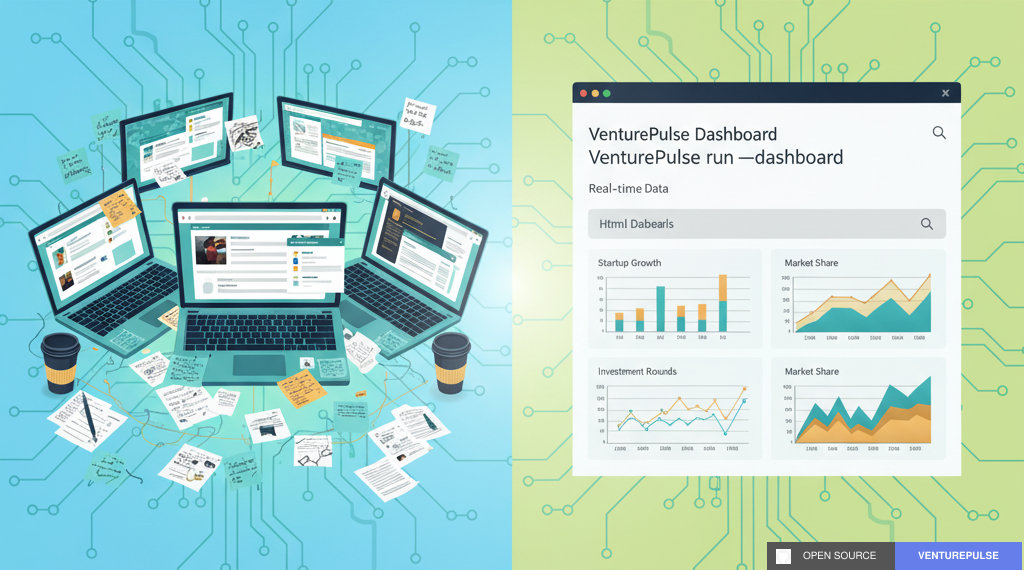
I spent long-hours over several weeks validating ideas with AI tools and hardcore research—asking questions, reviewing answers, finding gaps, repeating. So I built VenturePulse: an open-source tool that generates comprehensive viability analyses in one command. Here's what the reports look like.
You're sitting in an airport lounge when it hits you—the idea.
You frantically open your notes app and capture the essence before boarding. It feels brilliant. Revolutionary, even. But as you settle into your seat at 35,000 feet, the inevitable questions creep in:
- Is anyone already doing this?
- How would I actually build it?
- Would people pay for this?
- What are the risks I'm not seeing?
Sound familiar? I've had these moments. Most of these ideas die in the notes app graveyard, never making it past the initial spark.
Recently, I decided to do something different.
TL;DR
VenturePulse = Open-source CLI tool that generates comprehensive product viability reports in minutes
- Cost: $0 (free models) to $5 (Claude Sonnet 4.5)
- Time: 10-15 minutes for full analysis
- Output: McKinsey-style reports covering market, tech, financials, competition, MVP, GTM
- Setup: 5 minutes • No coding required • Works on Mac/Linux/Windows
The Validation Marathon
I had an idea I believed in, so I committed to validating it properly. What followed was weeks of research that included many long-hours very late into night:
- Competitive landscape analysis - Hunting down competitors, analyzing their features, pricing, positioning
- Market sizing - Estimating TAM, SAM, SOM with whatever data I could find
- Technical feasibility - Figuring out what tech stack, what APIs, what's actually buildable
- Financial modeling - Creating spreadsheets for unit economics, CAC, LTV, burn rate
- Risk assessment - Identifying regulatory hurdles, competitive threats, execution risks
Even with AI tools like ChatGPT and Claude helping me, the process was grueling.
I'd ask a question about competitors. Review the response. Realize I needed pricing data. Ask another question. Get an answer. Identify a gap in the technical feasibility analysis. Ask again.
It was like orchestrating 30 different conversations, trying to stitch together a coherent picture while keeping track of what I'd already asked, what I still needed, and where the gaps were.
The breakthrough realization: I was asking the same questions for every idea.
The playbook was identical:
- Who are the competitors?
- What's the market opportunity?
- How would I build this technically?
- What's the business model?
- What are the key risks?
- What should the MVP look like?
Why couldn't I package this entire playbook into a single, comprehensive prompt that would handle everything at once?
So I built it.
Introducing VenturePulse
VenturePulse is an open-source command-line tool that transforms a simple project description into a comprehensive, McKinsey-style viability analysis—complete with competitive research, financial projections, risk assessments, and go-to-market strategies.
The magic is in what I call the "mega-prompt"—a meticulously crafted prompt architecture that orchestrates both creative exploration and precision analysis in a single execution.
What Makes It Different
Most AI tools make you have a conversation. Ask questions. Clarify. Iterate. Repeat.
VenturePulse takes a different approach:
- No back-and-forth required - You provide your idea document, it produces a complete analysis
- Comprehensive coverage - 9 distinct analysis dimensions, each in its own focused report
- Research included - Automatically identifies and analyzes existing competitors
- Actionable outputs - Every report includes scores, recommendations, and next steps
- Model agnostic - Works with any LLM via OpenRouter (free models to Claude Sonnet 4.5)
The Architecture Evolution
Initially, I built this as a single "mega-prompt" that generated one massive 9-tab HTML page. It worked, but I hit token limits with complex ideas and the output was sometimes inconsistent.
A simple breakthrough: Break that darn mega-prompt into focused, sequential analyses.
The current version runs separate, specialized prompts in sequence, each building on insights from the previous reports. Each analysis produces its own focused HTML report, making the output more reliable, more detailed, and easier to digest.
Think of it like having multiple different expert consultants, each reviewing the work of the previous expert and adding their own perspective from their speciality.
What the Reports Actually Look Like
Let me walk you through what VenturePulse actually produces. I'll use screenshots from a real analysis to show you the depth and quality of insights.
1. Executive Summary: Your Go/No-Go Decision
The first report answers the only question that really matters: Should I build this?
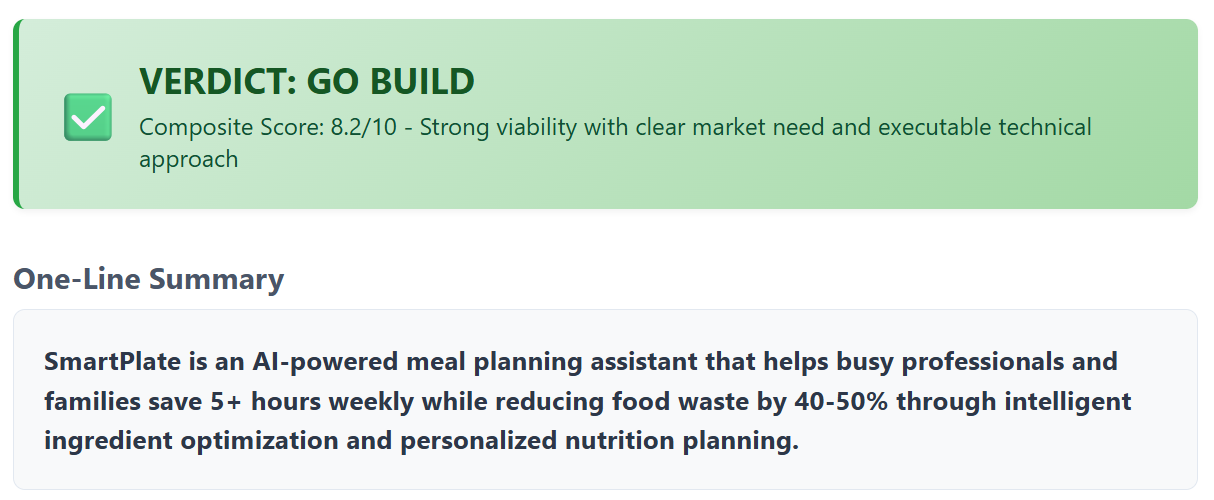
Within seconds of opening the report, you know whether to proceed. No ambiguity. No "it depends." Just a clear recommendation based on comprehensive analysis.
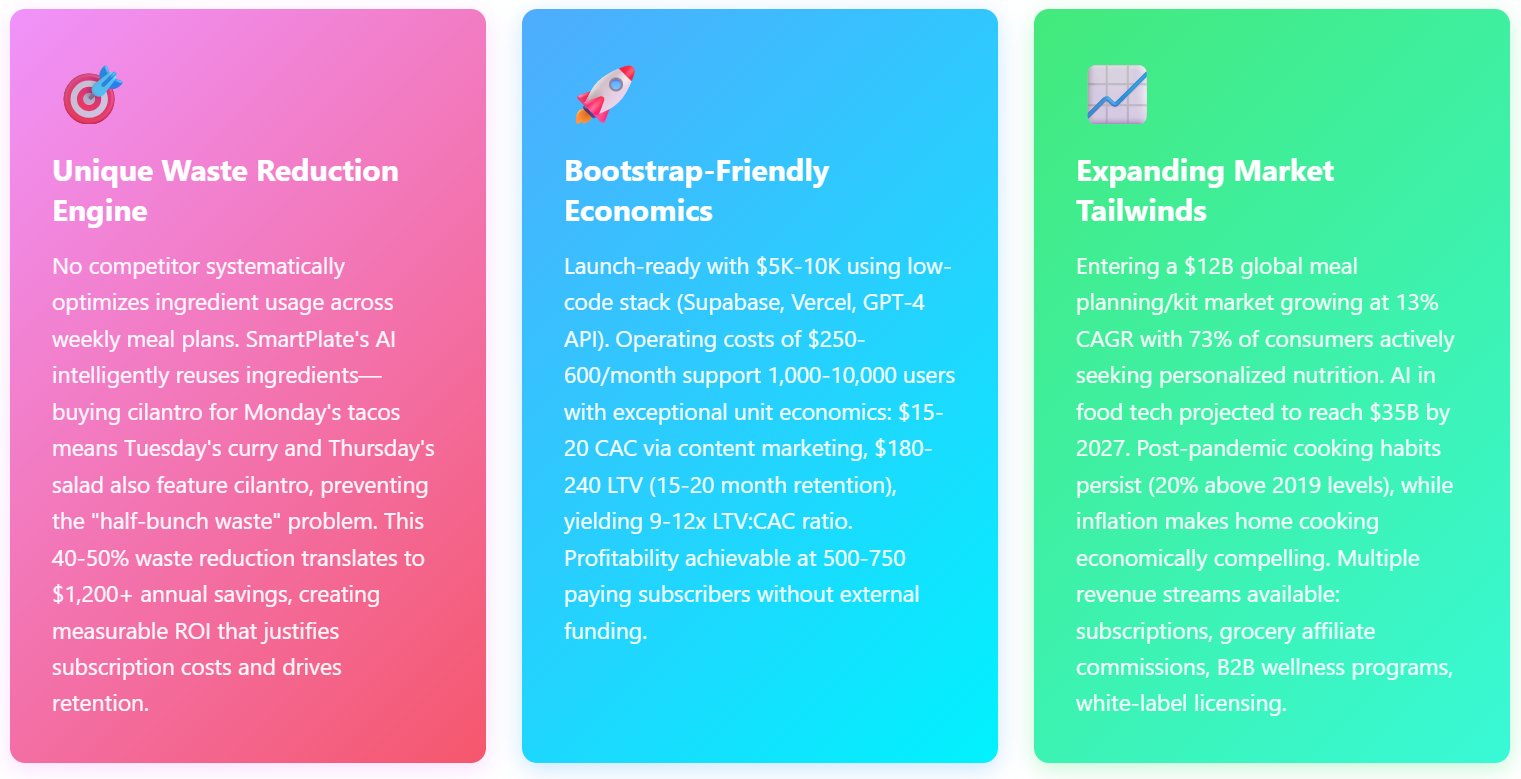
The executive summary identifies your idea's three strongest value propositions—the hooks you'd lead with when pitching investors or early customers.

This is where you see the quantified assessment:
- Market Validation - Is there proven demand?
- Technical Feasibility - Can you actually build this?
- Competitive Advantage - What makes this defensible?
- Business Viability - Can this be profitable?
- Execution Clarity - Is the path forward clear?
Any score below 8/10 comes with specific improvement recommendations. No vague feedback—just actionable gaps to address.
2. Market Landscape: Know Your Competition
This is where most founders skip ahead too quickly. VenturePulse forces you to confront the reality of your market.
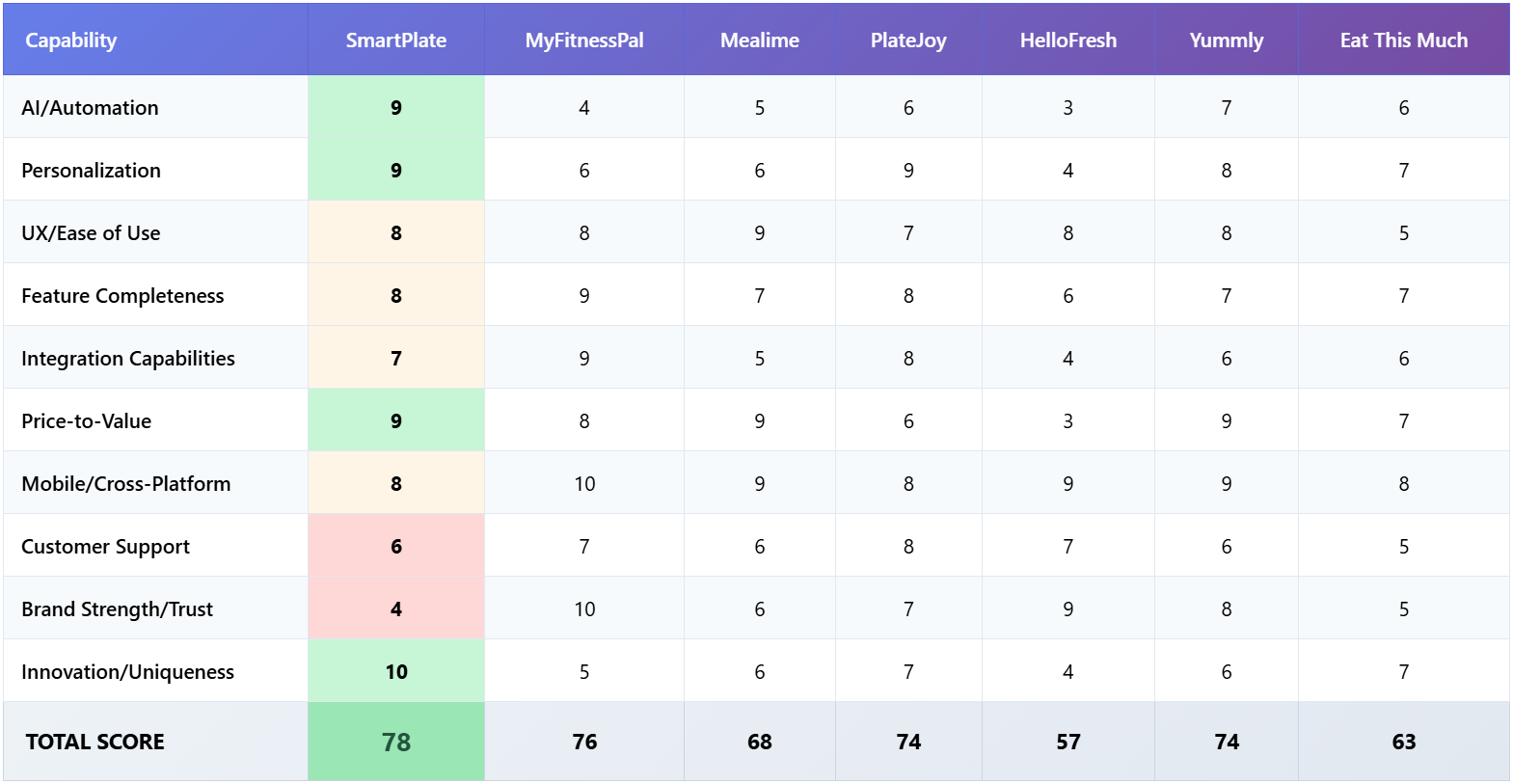
The tool doesn't just list competitors—it researches them, analyzes their positioning, and scores them against your proposed solution across dimensions like:
- Automation capabilities
- User experience
- Integration ecosystem
- Domain expertise
- Pricing model
You also get:
- Market Maturity Analysis - Is this a nascent market or crowded space?
- "Why Now?" Rationale - What macro trends make this the right timing?
- White Space Identification - Where are the clear gaps competitors aren't addressing?
- Market Size & Opportunity - Realistic TAM/SAM/SOM estimates
This report has saved me from pursuing "great ideas" in markets that are either too early (no one's ready to pay) or too late (already dominated by entrenched players).
3. Technical Feasibility: Can You Actually Build This?
Here's where rubber meets road. Ideas are cheap. Execution is everything.
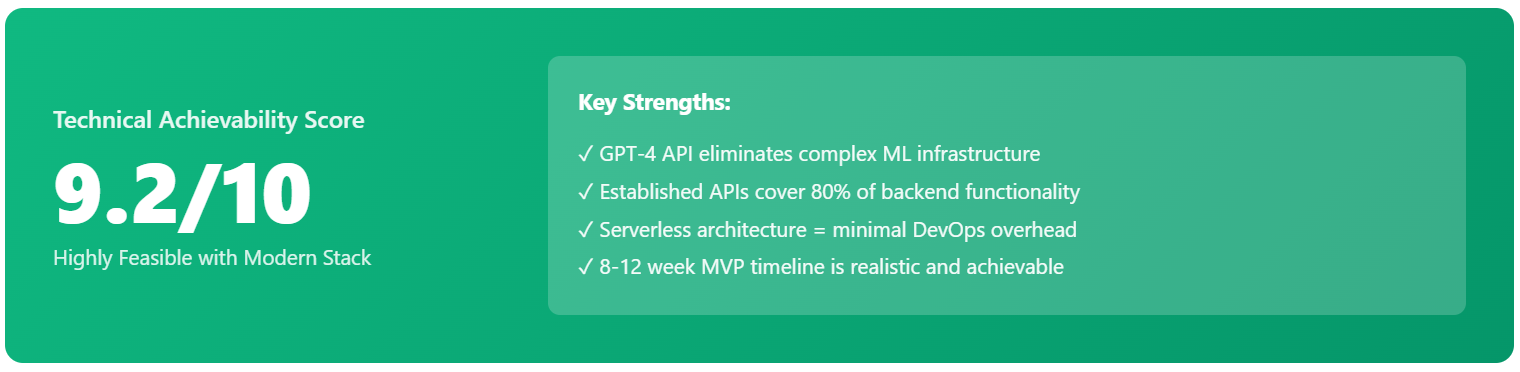
The feasibility assessment considers:
- Existing Tools & APIs - What can you leverage vs. build from scratch?
- AI/Low-Code Options - How much can be automated or no-coded?
- Technical Complexity - Realistically, how hard is this to build?
- Scalability Constraints - Where will you hit technical limits as you grow?
What I love about this section: It assumes you're a "vibe-coder" (my term for pragmatic builders who leverage existing tools) rather than a Google-scale engineering team. The recommendations are grounded in what's actually achievable for a small team or solo founder.
You also get:
- Implementation Complexity breakdown by component
- Technology Risk Assessment - Dependencies, API limitations, platform risks
- AI Implementation Strategy - Specific tools and approaches for leveraging AI
- Development Roadmap - Phased technical milestones
4. Competitive Advantage: What's Your Moat?
This is the "why you?" section. Every VC asks this. Every customer thinks this. This report forces you to have a compelling answer.
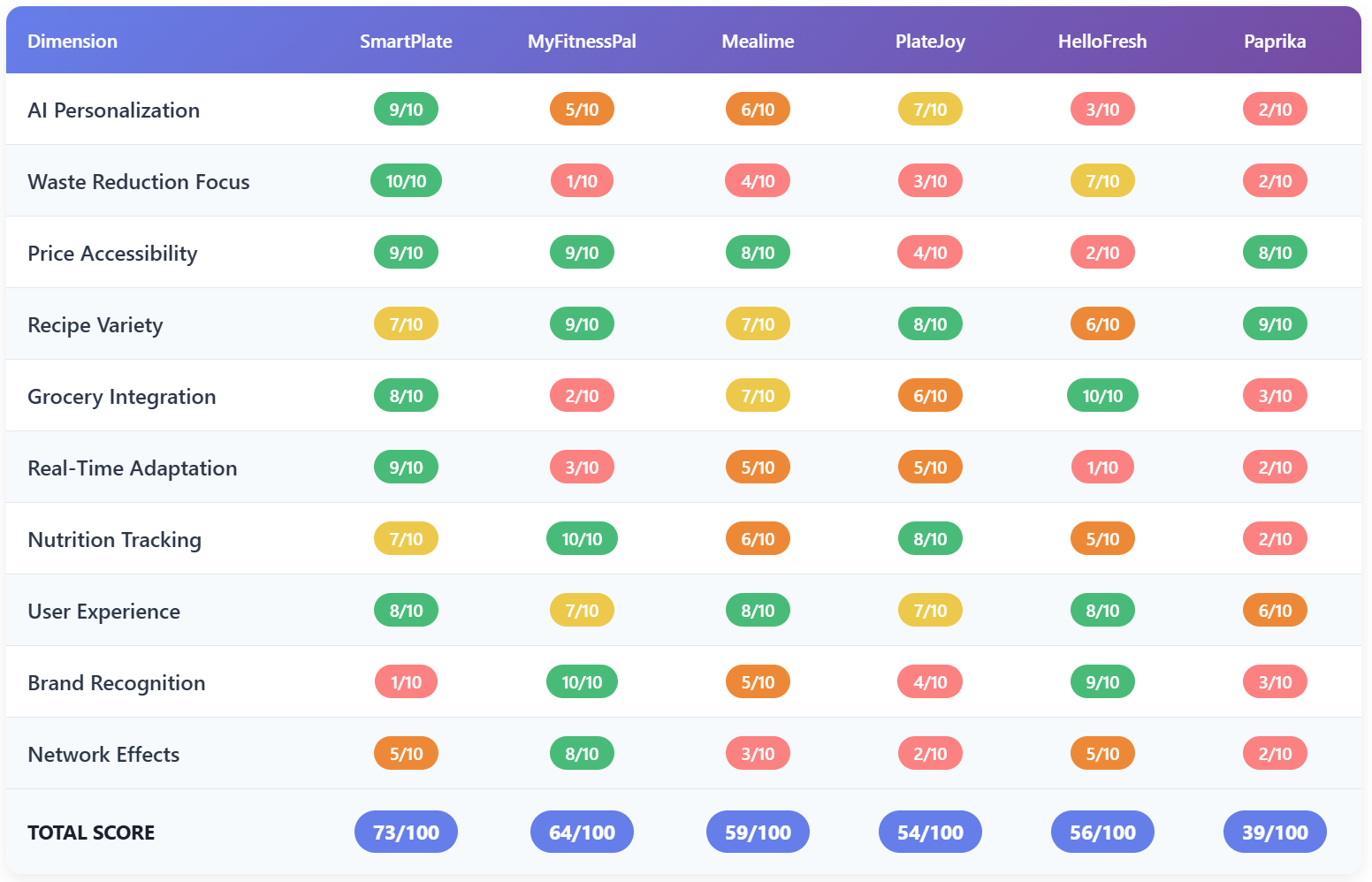
The competitive advantage report includes:
- Differentiation Factors - Your unique positioning and competitive edges
- Moat Analysis - Sustainable advantages that are hard to replicate:
- Proprietary data advantage
- Technical moat (AI models, integrations, automation)
- Switching costs and user lock-in potential
- Ecosystem leverage (partnerships, APIs, community)
- Long-Term Defensibility - Can you maintain advantage over 12-24 months?
This section is often sobering. Many "unique" ideas are actually... not that unique. But better to know now than after six months of development.
5. Business Model: Show Me the Money
Ideas don't become businesses until someone pays for them. This report tackles the economics head-on.
Key sections include:
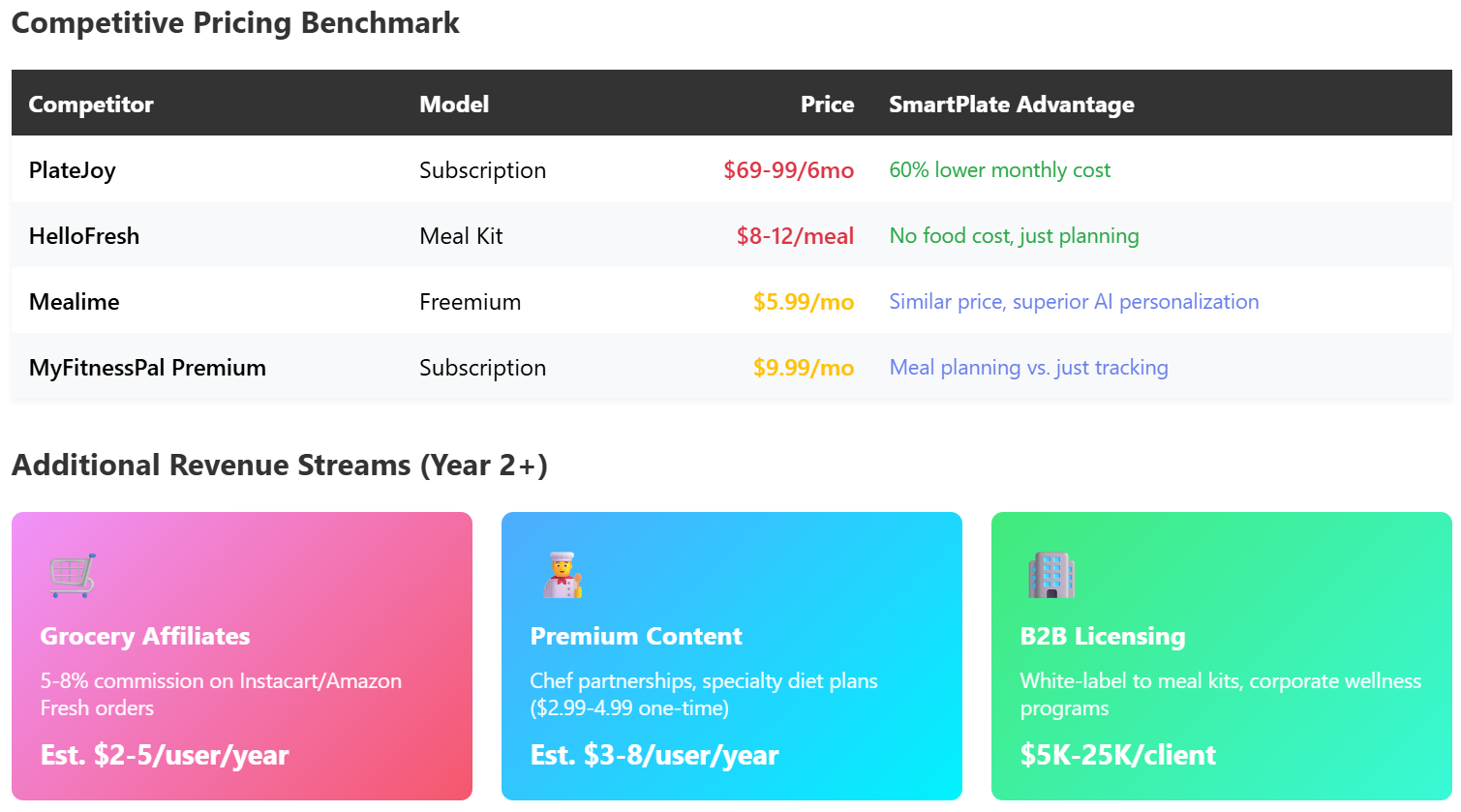
Revenue Model Analysis:
- Subscription vs. usage-based vs. marketplace models
- Pricing benchmarks from comparable solutions
- Revenue expansion pathways (upsells, cross-sells, enterprise tiers)
Cost Structure & Margins:
- Development costs (one-time and ongoing)
- Operational costs (hosting, APIs, support, etc.)
- Customer acquisition costs (CAC) estimates by channel
Financial Projections:
- Unit economics breakdown
- CAC/LTV ratios and payback periods
- Funding requirements and runway scenarios
Regulatory & Compliance:
This is where VenturePulse really shines—it doesn't let you ignore the boring-but-critical stuff:
- Professional licensing requirements
- Insurance and bonding needs
- Legal considerations (contracts, liability, IP)
- Security and privacy standards
I've seen too many founders build something amazing only to discover they need a license to operate in their target market, or that their unit economics don't work without VC-scale funding. This report surfaces those issues early.
6. MVP Roadmap: What to Build First
This is where vision meets reality. You can't build everything at once. But what should you build first?
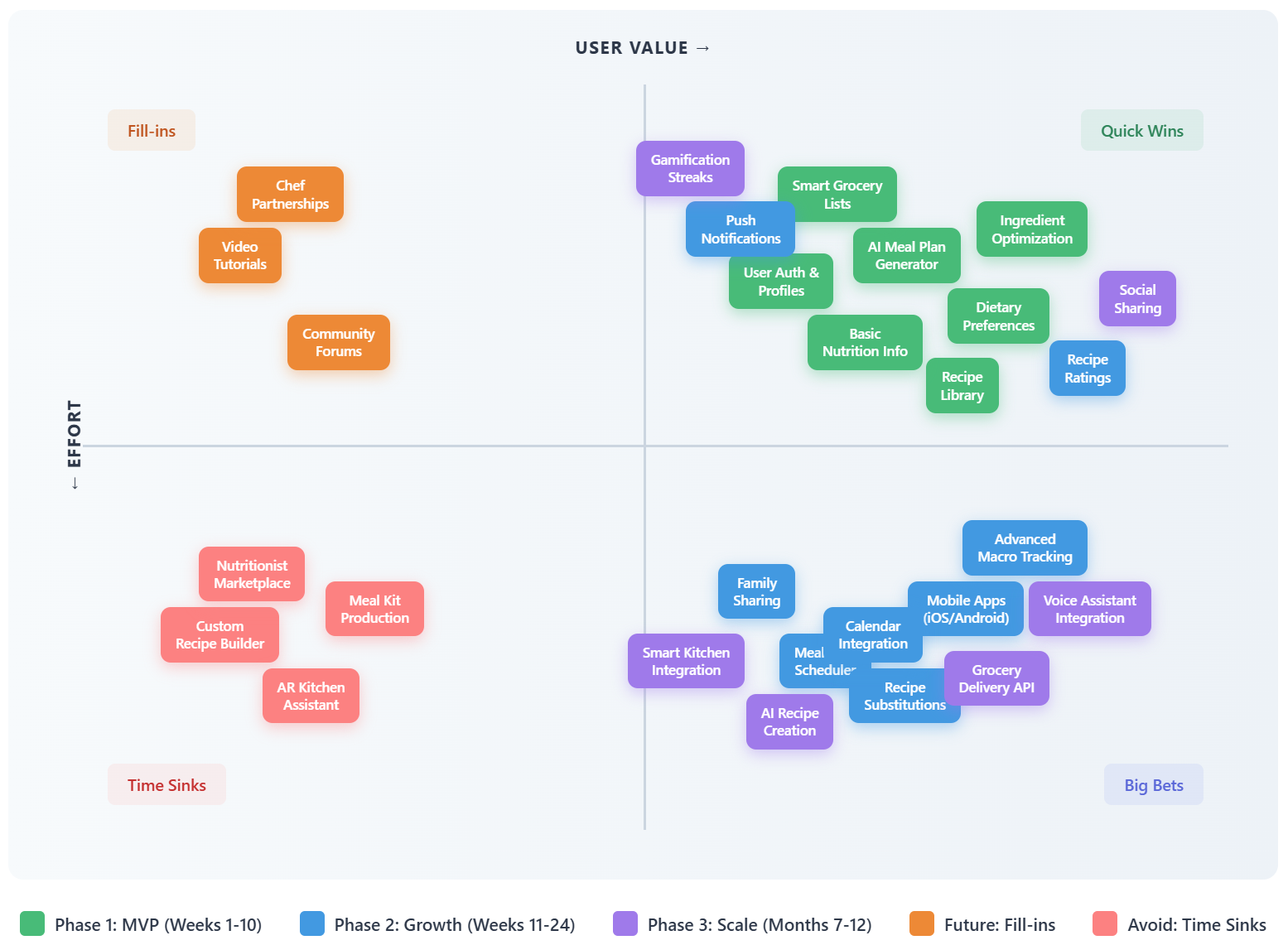
The MVP roadmap includes:
Feature Prioritization:
Features are categorized into:
- High Value, Low Effort - Build these FIRST (quick wins)
- High Value, High Effort - Core differentiators (MVP phase 2)
- Low Value, Low Effort - Nice-to-haves (backlog)
- Low Value, High Effort - Don't build (feature graveyard)
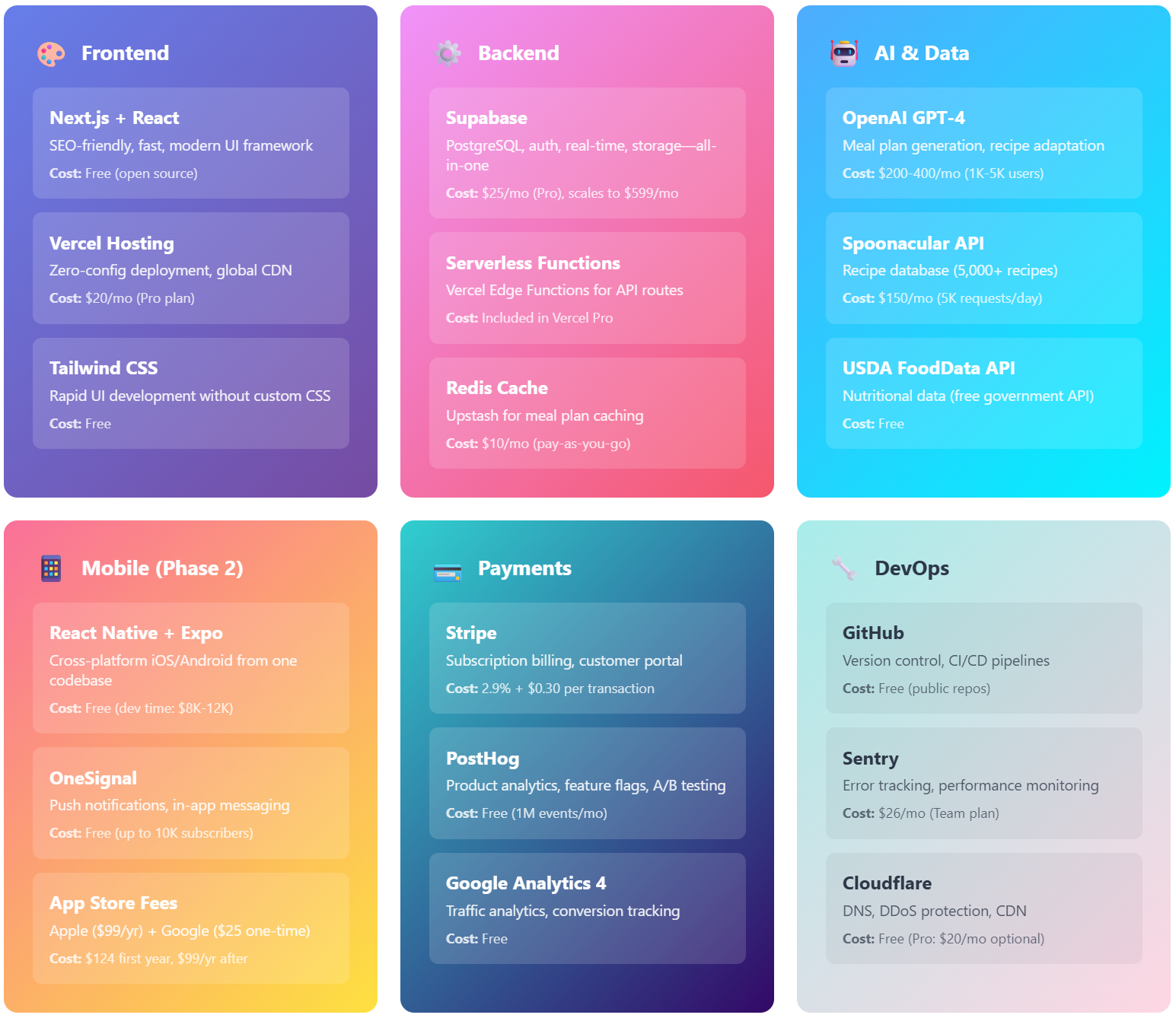
Rather than vague "use modern tools" advice, you get specific recommendations:
- "Use Stripe for payments, avoid building custom billing"
- "Leverage OpenAI's API rather than training custom models"
- "Start with Webflow or Framer for landing page, not custom React"
Phased Roadmap:
Clear phases from validation to scale:
- Validate - Prove the problem exists (2-4 weeks)
- Build - Create core MVP (4-10 weeks)
- Pilot - Test with early customers (11-24 weeks)
- Scale - Expand and optimize (7-12 months)
Each phase has success criteria so you know when to move forward vs. pivot.
7. Success Metrics: How You'll Know It's Working
This report answers: "What numbers should I be watching?"
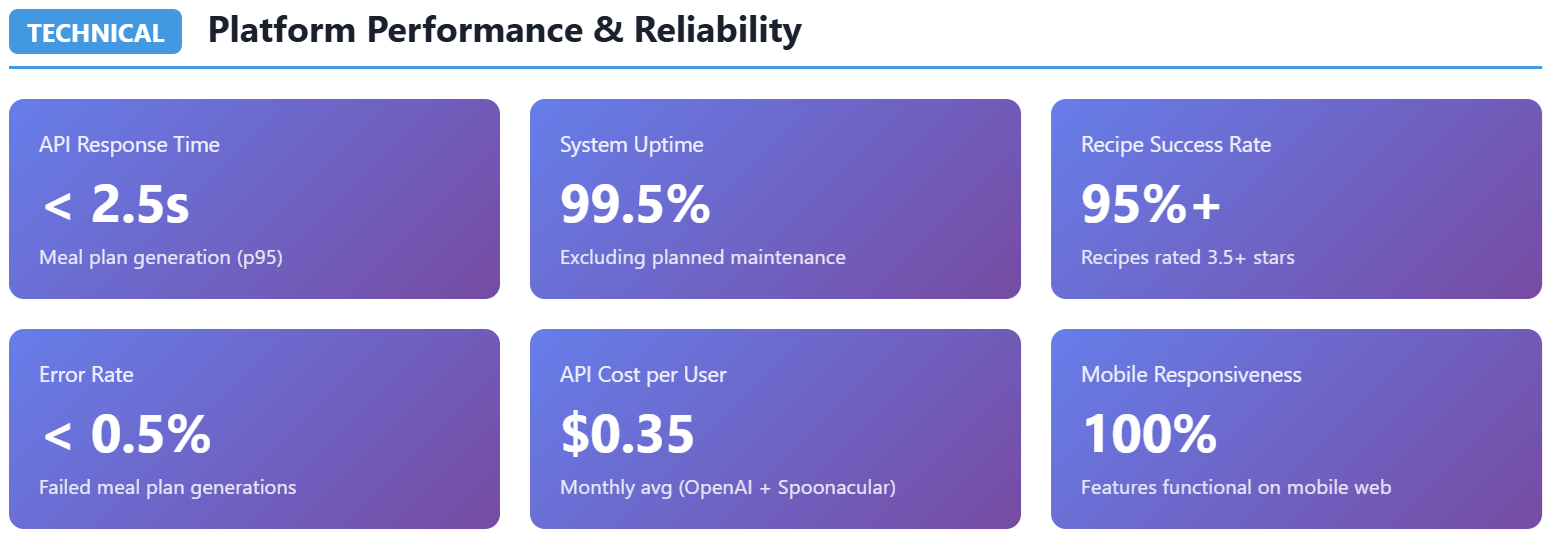
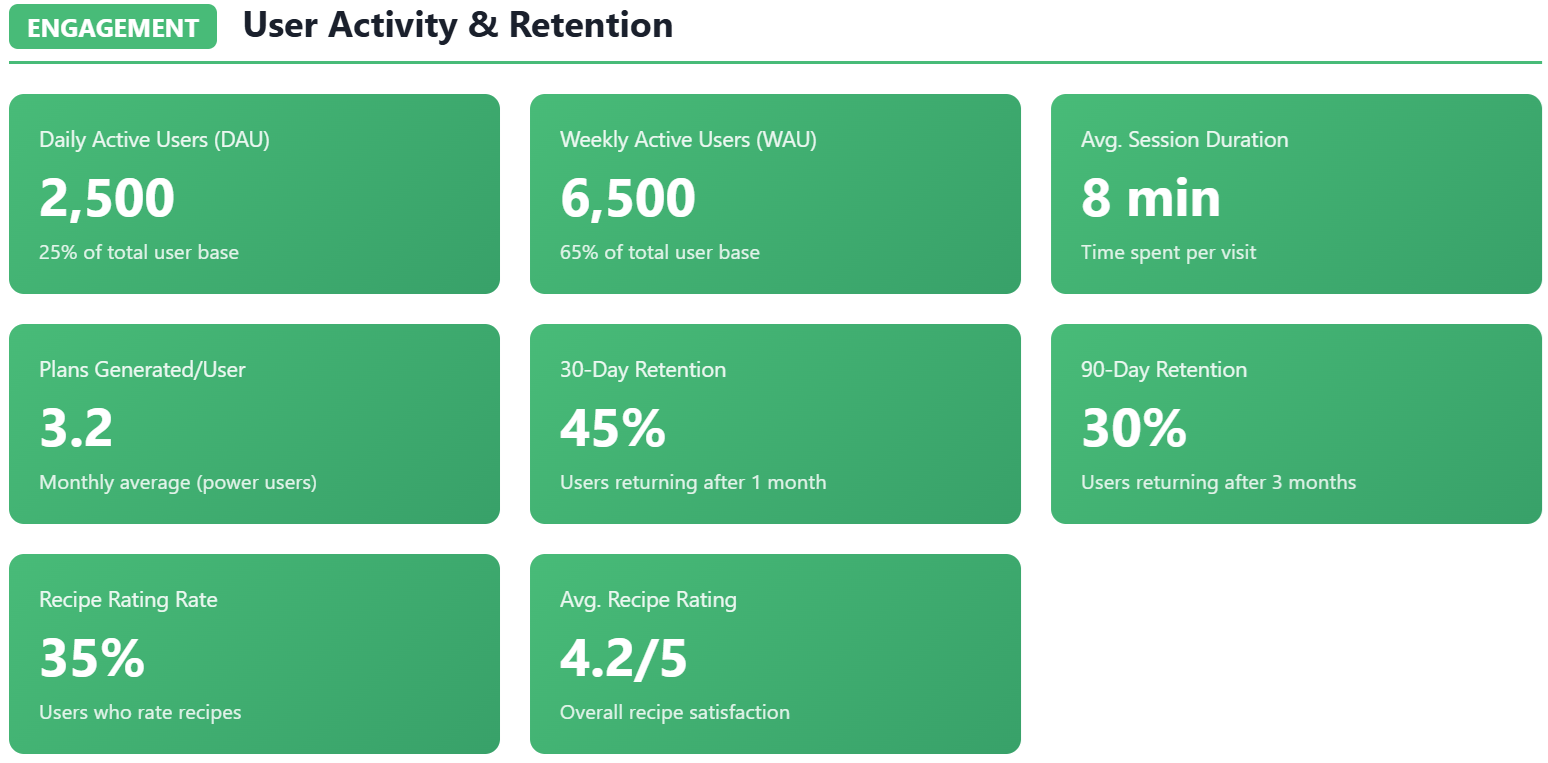
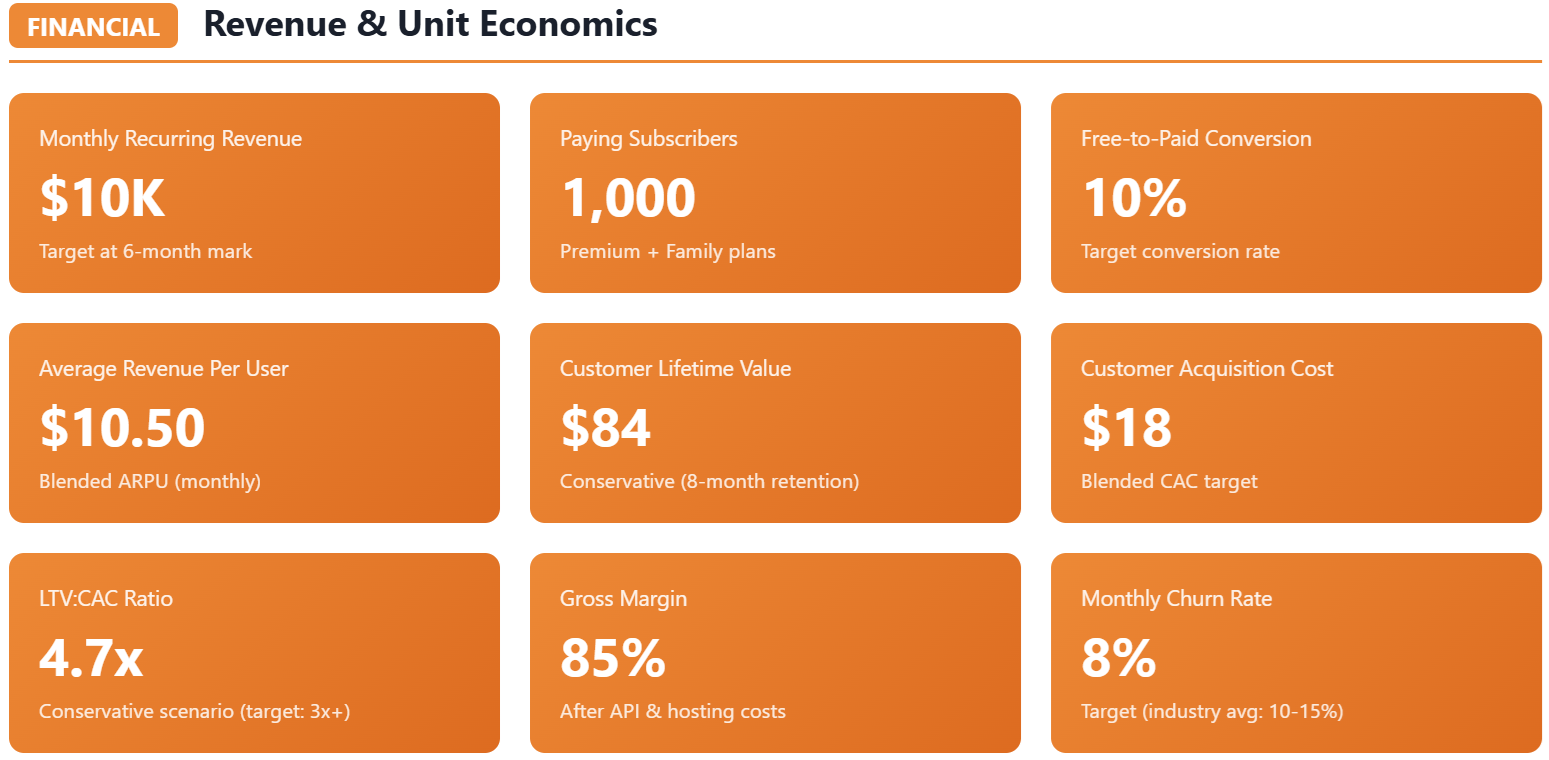

Quantified success indicators for technical, engagement, financial and growth metrics
You get specific KPIs tailored to your idea:
Technical Metrics:
- System uptime and performance
- API response times
- API Cost per User
- Error rates and resolution times
Engagement Metrics:
- User activation rate
- Core action completion rate
- Retention cohorts
Financial Metrics:
- LTV : CAC Ratio
- Gross Margin - GM
- Customer Acquisition Cost - CAC
- Average Revenue Per User - ARPU
- Monthly Churn Rate - MCR
Key Growth Metrics:
- Month-over-Month Growth
- Total Active Users
- Viral Coefficient
- Organic Traffic Share
- App Store Rating
Risk Register:
The report also includes a comprehensive risk assessment with:
- Probability ratings (Low/Medium/High)
- Impact assessment (Minor/Moderate/Severe)
- Specific mitigation strategies
- Early warning indicators
This is the "what could go wrong?" section that helps you prepare contingency plans rather than being blindsided.
8. Go-to-Market Strategy: How to Find Customers
Building a great product is only half the battle. This report tackles customer acquisition.
Ideal Customer Profile (ICP):
- Detailed persona of your target customer
- Pain points they're experiencing
- Where they currently look for solutions
- Decision-making process and buying criteria
Distribution Channels:
Ranked by fit for your specific idea:
- Direct sales vs. self-service
- Content marketing and SEO
- Partnerships and referrals
- Paid acquisition channels
- Community and viral loops
Go-to-Market Messaging:
- Core value proposition
- Key talking points for different audiences
- Objection handling strategies
- Competitive positioning statements
Partnership Strategy:
- Potential integration partners
- Channel partnerships
- Strategic alliances
This section often reveals non-obvious distribution strategies. For example, instead of "do content marketing," you might get "Target Slack communities for operations managers in healthcare tech companies—here's how to provide value and build trust before pitching."
9. Provenance & Metadata: Analysis Transparency
The final report documents how the analysis was generated:
- Model used (e.g., Claude Sonnet 4.5, GPT-4o, Gemini 2.0 Flash)
- Provider (OpenRouter)
- Analysis date and generation time
- Prompt version and strategy
- Total token usage and cost
This transparency serves two purposes:
- Reproducibility - You can rerun the analysis with a different model and compare
- Trust - You understand exactly how the insights were generated
The Model Economics: Free to Premium
Here's what I've learned testing VenturePulse across different models:
Free Models (Gemini 2.0 Flash, Llama 3.3)
- Cost: $0
- Quality: Decent for initial validation
- Speed: Very fast (2-3 minutes for full analysis)
- Best for: Testing the tool, validating obviously bad ideas quickly
Mid-Tier Models (GPT-4o, Gemini 2.0 Pro)
- Cost: $0.50 - $1.50 per full analysis
- Quality: Solid insights, good competitive research
- Speed: Moderate (5-8 minutes)
- Best for: Ideas you're moderately confident about and want deeper validation
Premium Deep Reasoning (Claude Sonnet 4.5, Gemini 2.5 Pro)
- Cost: $2 - $5 per full analysis
- Quality: Exceptional depth, nuanced analysis, catches non-obvious risks
- Speed: Slower (15-30 minutes)
- Best for: Ideas you're seriously considering building or pitching to investors
Always start with free models to filter obviously flawed or not so great ideas. For ideas that pass initial validation, run them through Claude Sonnet 4.5. The depth of analysis is worth every penny—you'll get insights that would cost thousands in consulting fees.
How to Use VenturePulse
Setup (5 minutes)
- Get an OpenRouter API key:
- Go to openrouter.ai
- Sign up for an account
- Add $5 credit (or use free models)
- Create & Copy your API key
- Download VenturePulse:
   # Option 1: Git clone
   git clone https://github.com/knightsri/VenturePulse.git
   cd VenturePulse

   # Option 2: Direct download
   # Download from: https://github.com/knightsri/VenturePulse/archive/refs/heads/main.zip
   # Unzip and navigate to the folder
- Set your API key:
export OPENROUTER_API_KEY='your-api-key-here'
Running an Analysis (2 minutes to start, 5-15 minutes to complete)
- Prepare your idea document:
- Can be .txt, .md, or .pdf
- Include: problem you're solving, target users, proposed solution, key features
- Length: 1-3 pages is ideal (more is fine, the tool handles it)
- Choose your model:
- Visit OpenRouter Models
- Search for a model (e.g., "Claude Sonnet")
- Copy the model identifier (e.g.,
anthropic/claude-sonnet-4.5) - Or use
google/gemini-2.5-flashfor free tier
- Run the analysis:
# Ensure the OPENROUTER_API_KEY is set in the Environment varaibles,
# or set the key in "analyze.sh" script - line #15

# Analyze your idea
./scripts/analyze.sh path/to/your-idea.md anthropic/claude-sonnet-4.5- Review the reports:
- Navigate to the generated folder (timestamped)
- Open any of the HTML reports in Chrome/Firefox
- Start with
executive-summary.html
That's it. What took me weeks now takes minutes.
Real-World Use Cases
Since releasing VenturePulse, I've seen it used for:
Side Project Validation:
"Should I spend my weekends building this, or is it a dead end?" - Get your answer in 10 minutes instead of 10 weeks.
Startup Pivot Decisions:
"We're considering pivoting from B2C to B2B SaaS. Does the economics work?" - Run comparative analyses to see which direction has better fundamentals.
Client Proposals:
"A client wants us to build X. Is it viable?" - Generate a comprehensive feasibility report before committing resources.
Investment Due Diligence:
"We're looking at investing in a startup. What are the risks?" - Get an independent, AI-powered second opinion on the opportunity.
Product Feature Prioritization:
"We have 10 feature ideas. Which should we build first?" - Run each through the MVP prioritization framework.
Why Open Source? Why Command-Line?
You might be wondering: "Why not build a sleek web app with drag-and-drop, user accounts, perform analysis?"
Fair question. Here's my thinking:
The Open Source Philosophy
- Transparency - You can see exactly how the prompts work and customize them
- Trust - No black box. You understand the methodology
- Flexibility - Fork it, modify it, make it your own
- Community - Others can contribute improvements and domain-specific variations
The Command-Line Advantage
- Security - Your API key never leaves your machine
- Simplicity - No servers, no databases, no deployment complexity
- Speed - No UI development, no auth flows, just pure functionality
- Ownership - The reports are HTML files you own forever
I may build a web UI eventually. But this approach gets the core value—comprehensive viability analysis—into people's hands immediately. No waitlists. No onboarding. Just clone and run.
Customization: Make It Your Own
One of the most powerful aspects of VenturePulse is its modularity. The prompt structure lives in prompts/sections/, and you can easily customize it for your domain.
Example Customizations:
For SaaS Products:
Add a section analyzing:
- Integration ecosystem potential
- API-first architecture considerations
- Freemium vs. paid-only strategies
For Physical Products:
Add sections for:
- Manufacturing and supply chain analysis
- Inventory and fulfillment complexity
- Retail vs. DTC distribution
For Regulated Industries:
Expand the compliance section with:
- Industry-specific certification requirements
- Regulatory approval timelines
- Ongoing compliance costs
For Non-Profits:
Replace business model analysis with:
- Grant funding landscape
- Donation model viability
- Impact measurement frameworks
To customize:
- Add your new section as a .md file in
prompts/sections/ - Update
analyze.sh(lines 124-131) to include your new sections, or drop the ones you don't care to run. Just make sure the file-slug reflects the actual prompt filenames you created. - Run the analysis
The tool handles the rest—generating a focused report for your custom section and incorporating insights into the overall analysis.
Your input matters: Star the repo if you find it useful, and open issues for features you want to see.
Try It Yourself
I've included example analyses in the examples/ folder so you can see the quality of output before running it yourself.
Quick Start:
- Check out the example project-idea and various model reports in
examples/sample-project - Read the README: github.com/knightsri/VenturePulse
- Set up OpenRouter (5 minutes)
- Run your first analysis
Cost to try: $0 (use free models) to $5 (premium analysis)
Time investment: 10 minutes to set up, 5-15 minutes per analysis
Potential value: Weeks of research compressed into minutes, helping you see the lay of the land in one sitting before deciding to pursue further or not. I sincerely hope VenturePulse help you avoid costly mistakes and pursue the right kind of opportunities.
Final Thoughts
The barrier to validating startup ideas has never been lower. What used to require:
- Weeks of manual research
- Thousands in consulting fees
- Dozens of fragmented AI conversations
- Specialized knowledge across business, tech, and strategy
Now requires:
- A simple text document describing your idea
- $5 in API credits (or $0 with free models)
- 10 minutes of execution time
- One command
The only question left is: What will you build?
I built VenturePulse because I was tired of great ideas dying in my notes app. I wanted a way to quickly separate "shower thoughts" from "fundable concepts."
Now you have that same tool too. Try it out and share the knowledge!!!
What idea have you been sitting on? Validate it. You might be surprised by what you discover.
Resources
- GitHub Repository: github.com/knightsri/VenturePulse
- Direct Download: Download ZIP
- OpenRouter: openrouter.ai
- Example Reports: View on GitHub
- Full Documentation: README.md
Have questions? Want to share your analysis results?
Drop a comment below or reach out on LinkedIn. I'd love to see what you're building and how VenturePulse helped validate (or invalidate) your ideas.
If you found this useful, consider:
- ⭐ Starring the repo on GitHub
- 📣 Sharing this with fellow builders
- 💬 Contributing improvements or domain-specific templates
Let's build better products, faster. Together.